The growing importance of ESG and how Erudus can help






ESG isn’t just a buzzword or a trend - yes, Environmental, Social and Governance is a fundamental shift in how businesses are being evaluated, driven by consumers, investors, and regulators.
And when it comes to ESG, data is power. The ability to collect, manage, and share verifiable ESG data (like packaging weights or ethical accreditations) is essential for proving a company's commitment.
That’s why it is more important than ever to utilise Erudus by recording or gathering this data. Allow us to explain...
What is ESG?
ESG is the acronym for environmental, social and governance - it was first popularised in a 2004 report undertaken by various financial institutions at the invitation of the United Nations (UN), but is now widely seen as the umbrella terms for “a set of aspects, including environmental issues, social issues and corporate governance that can be considered in investing.”
What does ESG mean for foodservice?
In the UK, the foodservice industry is increasingly focused on achieving sustainable and ethical supply chains.



And this isn’t just an independent movement used by businesses for PR - the focus is being driven through industry organisations such as the Federation of Wholesale Distributors (FWD), and consequently, Wholesalers are auditing their suppliers to ensure compliance in several different areas related to ESG.
- A connected supply chain is vital - a single company cannot achieve its ESG goals alone.
- A platform like Erudus helps to facilitate transparent information throughout the entire supply chain
- ESG is becoming a central part of business operations
For Manufacturers specifically
- Manufactuers are now more likely to receive requests from Retailers and Wholesalers to report on their ESG performance.
- Erudus provides a way for them to centralise and share key data, such as waste packaging information (E), or accreditations that prove ethical sourcing (S).
- This data helps them win and retain business with customers who have their own strict ESG criteria.
For Wholesalers specifically
- Wholesalers may now be asked by customers (especially those such as corporate clients, schools, hospitals) for information about the sustainability and ethics of the products they supply.
- Erudus enables Wholesalers to easily access and filter products based on this data. For example, you can search for products with Fairtrade or Organic certifications, which fall under the Social and Environmental pillars of ESG.
- Erudus provides a clear audit trail that helps you prove compliance and ethical sourcing to your stakeholders.



How Erudus is helping Manufacturers with ESG
The Erudus ESG survey for Manufacturers is our solution to helping our Manufacturer users communicate compliance with ESG - we’ve identified that for suppliers, responding to these kinds of audits can be administratively intensive and in a bid to reduce time spent answering multiple surveys of similar questions, going forward Erudus Wholesalers will be able to review a standardised ESG survey across all of their suppliers within Erudus.
Here’s what you need to know about the Erudus ESG Survey for Manufacturers:
- We have introduced the ESG survey to streamline the communication of information through the supply chain in the UK and make life easier for our users.
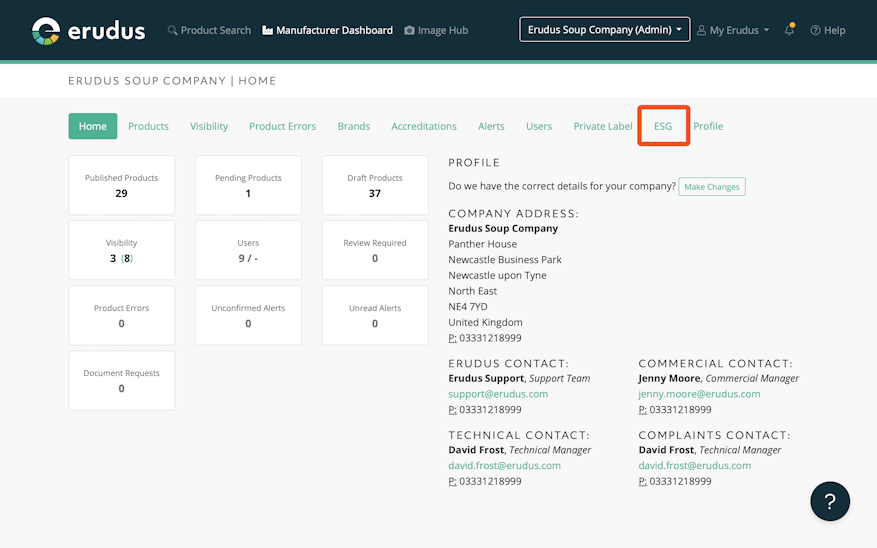
- On the Manufacturer dashboard you’ll find a section labelled “ESG”. Here, you can complete and submit the ESG survey
- Once completed, the responses submitted will be available for review by all of your Wholesalers
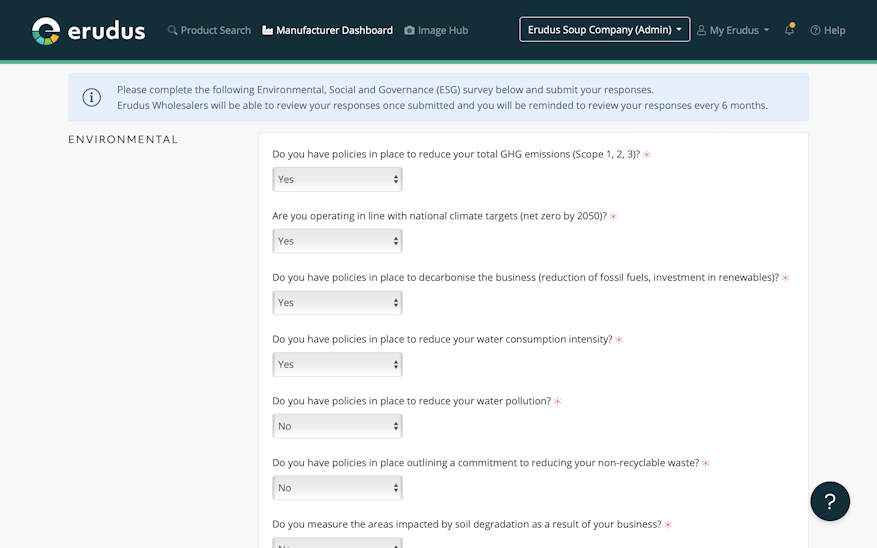
- The survey is composed of mostly yes/no questions, and should only take around 15 minutes to complete



What questions are in the Erudus ESG survey for Manufacturers?
The questions on the Erudus survey are broken down into the ESG headings, and you can find the questions below, defined by category:
Environmental
- Do you have policies in place to reduce your total Green House Gas (GHG) emissions (Scope 1, 2, 3)?
- Are you operating in line with national climate targets (net zero by 2050)?
- Do you have policies in place to decarbonise the business (reduction of fossil fuels, investment in renewables)?
- Do you have policies in place to reduce your water consumption intensity?
- Do you have policies in place to reduce your water pollution?
- Do you have policies in place outlining a commitment to reducing your non-recyclable waste?
- Do you measure the areas impacted by soil degradation as a result of your business?
- Do you measure the impact your business has on biodiversity in the region?
- Do you have policies in place to support a thriving ecosystem and surrounding environment?
- Are you committed to no deforestation for directly sourced deforestation linked commodities by 2025 and guaranteeing a supply in line with this commitment?
- Are you requiring 100% of palm oil used as a direct ingredient in food to be third-party certified sustainably sourced?
- Are you Deposit Return Scheme (DRS) ready?
Social
- Do you promote positive relations within the local community (supplying local businesses, training and employing locals, supplying into the local public sector)?
- Do you have diversity and inclusion policies in place?
- Do you have an employee health and safety policy in place?
- Do you have a human rights policy in place?
- Are you in compliance with UK labour standards (minimum wage, minimum age, maximum hours, minimum holiday, sick leave)?
- Do you have parental leave?
- Do your employees have the freedom of association and the right to unionise?
- Do you have an employee benefits package in place?
- Do you work philanthropically with the community (charity scheme, investing into the local community, investing into employees)
Governance
- Are you committed to having board independence and diversity?
- Do you have an anti-corruption policy in place and ensure ethical business conduct?
- Do you conduct regular audits and risk management practices?
- Do you ensure you are operating in compliance with national regulations?
- Do you conduct transparency of reporting?
- Do you ensure that the board is transparent in how it operates?
How Erudus is helping Wholesalers with ESG
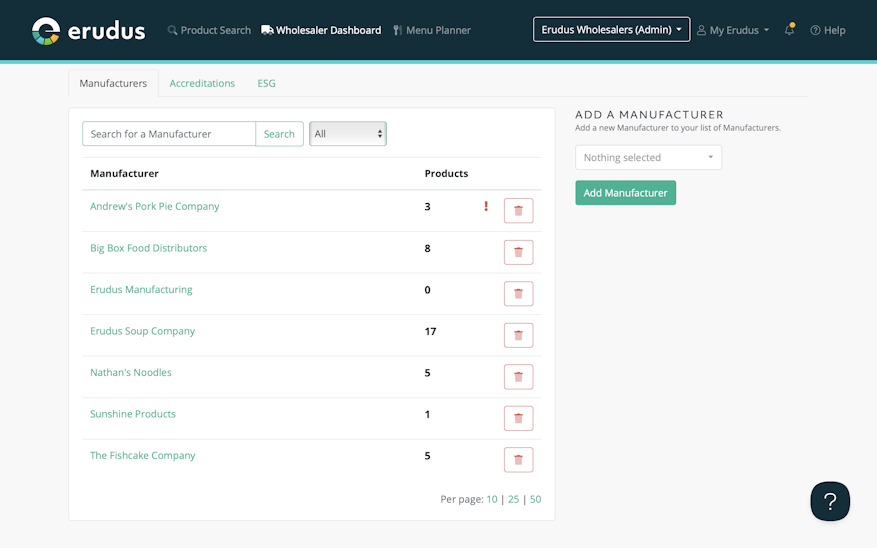
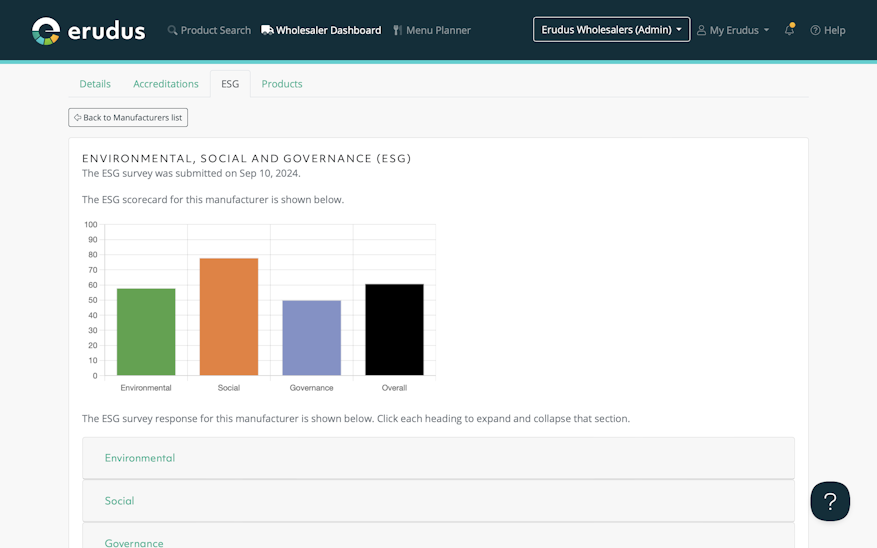
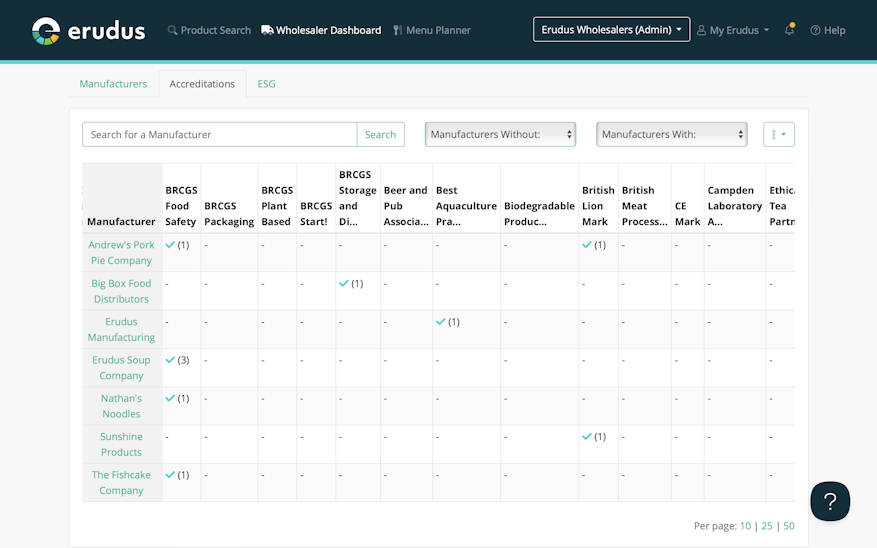
Erudus introduced Manufacturer Management Tools so Wholesaler users can review the products, accreditations and ESG (Environmental, Social and Governance) status of any Erudus Manufacturers they do business with.
Here’s what you need to know:
- Manufacturer Management Tools allow Erudus Wholesaler users to create a list of the Manufacturers that they do business with in Erudus.
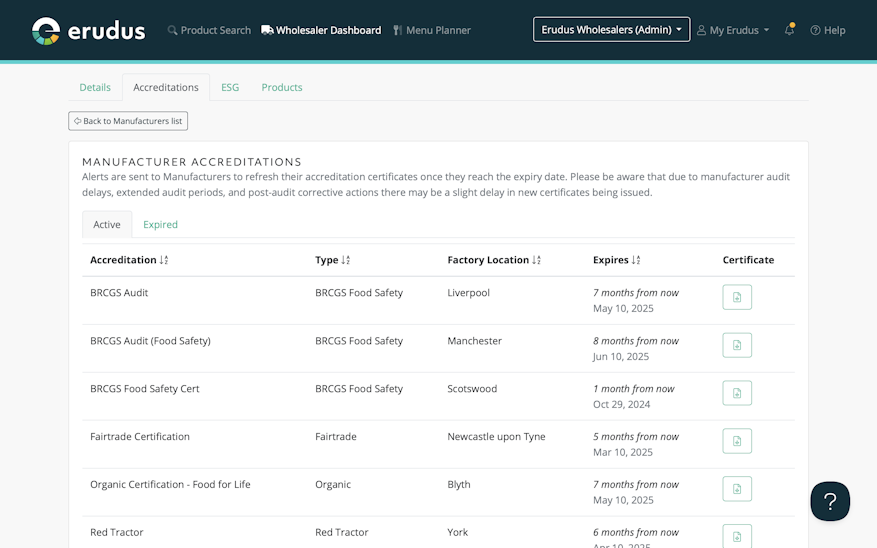
- Once the list is populated they can review how many products from each Manufacturer the Wholesaler has a product code attached to, the number of active accreditations of each type that Manufacturers have (and the Wholesaler can also download accreditations the Manufacturers have published)
- You can get both a scorecard for each Manufacturer and a rolled up score for all Manufacturers to assess ESG impact based on a Wholesaler’s supply chain
- Review product code allocation ensures that gaps are filled by easily identifying missing lines
- Verify supplier claims by ensuring accreditations are published to Manufacturer accounts so that Wholesalers can access them easily to be compliant when they are audited
- Get ahead with the growing focus on ESG credentials/compliance within the foodservice supply chain in the UK, including the Federation of Wholesale Distributors setting government-beating targets for all FWD members to be Net Zero by 2040




Further Resources
You can find more indepth information about ESG and the Erudus tools that support our users in complying with it at the below:
Knowledge Base - What is ESG?
The Erudus ESG Survey for Manufacturers Guide
Knowledge Base - How to fill out the Erudus ESG Survey for Manufacturers
Knowledge Base - What is ESG for Wholesalers?
Manufacturer Management Tools for Whoelsalers
You may also be interested in…


You may also be interested in…
All about Extended Producer Responsibility
ReadYou may also be interested in…


You may also be interested in…


